
Introduction
Cricket has produced some of the greatest sporting achievements ever witnessed. From marathon innings that lasted for days to bowlers taking impossible numbers of wickets and teams rewriting history with record-breaking performances, the sport is filled with milestones that continue to inspire fans across generations. Whether you follow Test cricket, One Day Internationals (ODIs), or Twenty20 (T20) matches, there are countless cricket records that showcase the game’s evolution and the extraordinary talent of its players.
Understanding the biggest records in cricket history is about more than memorizing statistics. These achievements reveal how the sport has changed over time, highlight the impact of legendary players, and provide context for modern records being set today. Fans often search for cricket world records list, all-time cricket records, test cricket statistics and records, and best records in cricket history to compare today’s stars with the legends of previous generations.
This guide brings together the most remarkable cricket records across batting, bowling, fielding, wicketkeeping, team performances, and ICC tournaments. It also explains why many of these milestones remain unmatched despite advances in fitness, technology, and playing conditions. Whether you’re a new cricket enthusiast or a lifelong fan, this comprehensive guide will help you understand the records that define the sport.
What Are the Biggest Records in Cricket History?
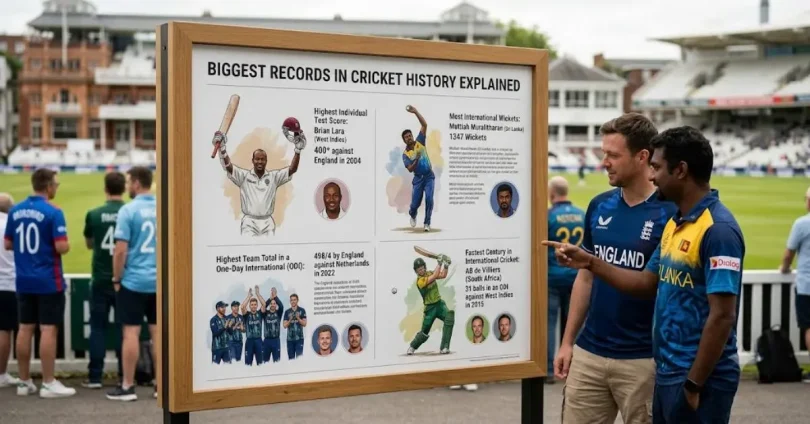
The biggest records in cricket history are statistical achievements that stand out because of their rarity, longevity, or difficulty to surpass. These include:
- Highest individual scores
- Most career runs
- Most wickets
- Fastest centuries
- Highest team totals
- Longest winning streaks
- Outstanding World Cup performances
Many of these records have remained untouched for decades, making them some of the greatest achievements in sports history.
Cricket Records Across Different Formats
Cricket records vary depending on the format.
| Format | Main Characteristics | Popular Records |
|---|---|---|
| Test Cricket | Five-day matches | Most runs, wickets, highest scores |
| ODI Cricket | 50 overs | Double centuries, highest team totals |
| T20 Cricket | 20 overs | Fastest fifties, biggest chases |
| First-Class Cricket | Domestic multi-day | Historic batting and bowling records |
| ICC Tournaments | World Cups & Champions Trophy | Tournament records |
Each format rewards different skills, making comparisons between players both fascinating and challenging.
Why Cricket Records Matter
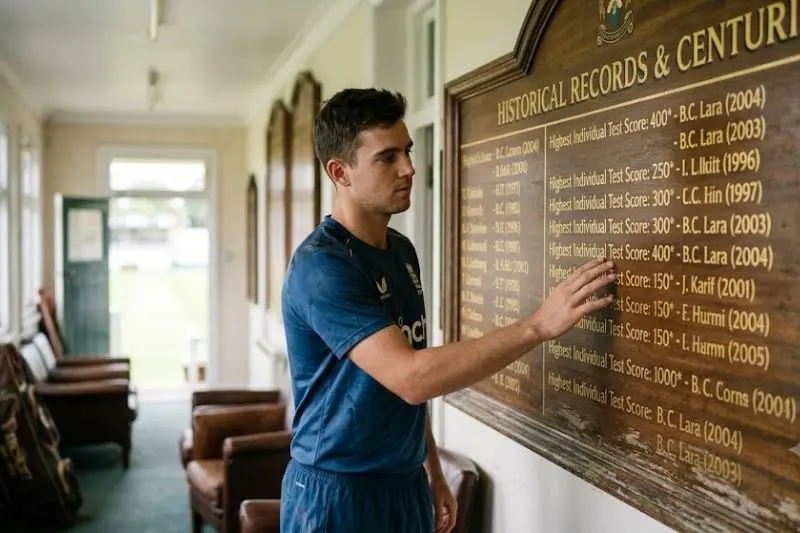
Records are more than numbers. They help fans understand greatness across different eras.
They also:
- Preserve cricket history
- Highlight exceptional performances
- Inspire future generations
- Help compare legendary players
- Show how the game has evolved
Organizations such as the International Cricket Council (ICC) and Wisden maintain historical statistics that are widely respected throughout the cricketing world.
Legendary Batting Records
Most International Runs
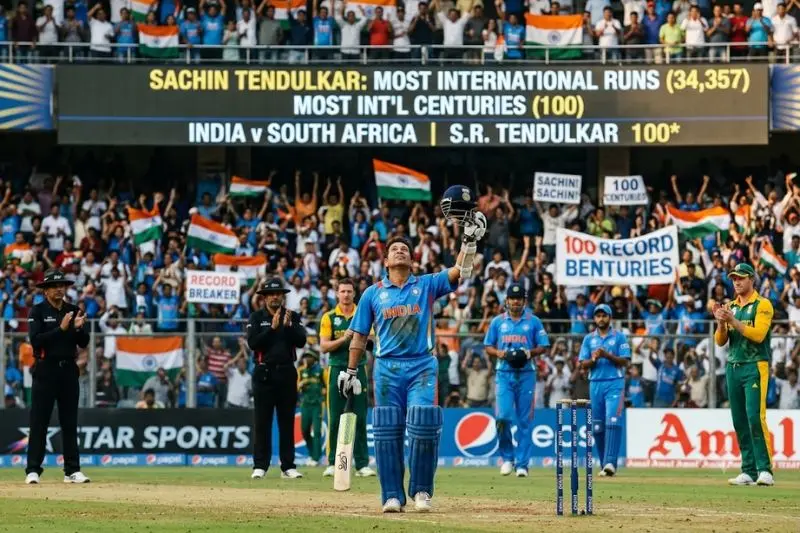
No discussion about cricket records begins anywhere other than Sachin Tendulkar.
His international career lasted over two decades and established numerous records that remain benchmarks for modern players.
Some of his most famous achievements include:
- Over 34,000 international runs
- 100 international centuries
- Most Test matches played
- Most ODI runs
His consistency across formats is considered one of cricket’s greatest accomplishments.
Highest Individual Score in Test Cricket
One of cricket’s most famous records belongs to Brian Lara, who scored:
400 against England*
This innings remains the highest individual score in Test cricket history.
What makes this achievement remarkable is not only the number of runs but the patience, concentration, and skill required over multiple days.
Highest Individual Score in ODI Cricket
Modern ODI batting has become increasingly aggressive.
The current highest ODI individual score belongs to Rohit Sharma, who scored:
264 runs against Sri Lanka
This innings included:
- 33 fours
- 9 sixes
- One of the greatest ODI innings ever played
Many experts consider it nearly impossible to surpass.
Most International Hundreds
Scoring a century consistently over many years is one of cricket’s toughest challenges.
The all-time leader remains:
Sachin Tendulkar – 100 international centuries
This incredible milestone combines both Test and ODI cricket and has stood as one of sport’s greatest statistical achievements.
Fastest Century in ODI Cricket
Power hitting has transformed modern cricket.
One unforgettable record belongs to AB de Villiers, who reached:
100 runs in just 31 balls
The innings showcased extraordinary innovation, timing, and attacking stroke play.
Highest Individual Score in T20 International Cricket
T20 cricket rewards aggressive batting unlike any other format.
Some of the biggest T20I scores have exceeded 170 runs, demonstrating how dramatically batting has evolved over the last decade.
Greatest Bowling Records
While batters often receive more attention, bowlers have created some of cricket’s most astonishing records.
Most Test Wickets
The highest wicket-taker in Test cricket is:
Muttiah Muralitharan
His remarkable career included:
- More than 800 Test wickets
- Exceptional spin bowling
- Match-winning performances across all conditions
Many cricket analysts consider this one of the hardest records in sports to break.
Most International Wickets
Across all formats, Muralitharan also tops the wicket charts.
His consistency across Tests and ODIs demonstrates remarkable longevity.
Best Bowling Figures in a Test Innings
One of cricket’s oldest legendary performances belongs to:
Jim Laker
He produced astonishing bowling figures of:
19 wickets in a single Test match
This achievement has stood for generations and is widely regarded as one of cricket’s greatest bowling performances.
Best Bowling Figures in ODI Cricket
Exceptional ODI bowling performances have produced unforgettable figures despite batting-friendly conditions.
Among the greatest spells is:
Chaminda Vaas – 8 wickets for 19 runs
Such performances remain extremely rare in limited-overs cricket.
Most Hat-Tricks
Taking three wickets in three consecutive deliveries is one of cricket’s rarest achievements.
Only a handful of international bowlers have recorded multiple hat-tricks, making this one of cricket’s most exciting milestones.
The Greatest All-Round Records
True all-rounders contribute with both bat and ball.
Legends such as:
- Jacques Kallis
- Garfield Sobers
- Kapil Dev
- Imran Khan
- Ben Stokes
have built careers by excelling in every department.
Some of the most impressive all-round achievements include:
- Thousands of runs
- Hundreds of wickets
- Match-winning performances in all conditions
- Consistency across multiple decades
Record-Breaking Wicketkeeping Achievements
Wicketkeepers play one of the most demanding roles in cricket.
Historic records include:
- Most dismissals in international cricket
- Most catches in Tests
- Most stumpings in ODI cricket
- Fastest glove work behind the stumps
Players like Mark Boucher, Adam Gilchrist, Kumar Sangakkara, and MS Dhoni are among the greatest wicketkeepers the sport has produced.
Official Sources for Cricket Statistics
For verified cricket records and historical statistics, the most trusted references include:
- International Cricket Council (ICC)
- Wisden Almanack
- ESPNcricinfo Stats Database
These organizations maintain comprehensive databases covering international and domestic cricket records.
Detailed Core Guide (Continued)
Greatest Team Records in Cricket History
While individual brilliance often captures headlines, cricket is ultimately a team sport. Some of the most iconic records belong to national teams that dominated entire eras or produced unforgettable performances under pressure.
Highest Team Total in Test Cricket
The highest team score in Test cricket belongs to Sri Lanka, who amassed:
952/6 declared vs India (1997)
This monumental innings featured:
- Sanath Jayasuriya – 340
- Roshan Mahanama – 225
- A partnership of 576 runs, which remains one of the greatest in Test history.
The record reflects extraordinary endurance, batting depth, and favorable playing conditions.
Highest Team Total in ODI Cricket
Modern ODI cricket has seen batting records shattered repeatedly, but the highest total currently belongs to:
Australia – 434/4
Shortly after, South Africa famously chased 434, creating one of the greatest ODI matches ever played. Since then, England and other teams have also crossed the 480-run mark, demonstrating how limited-overs batting has evolved with aggressive strategies and power-hitting.
Highest Team Total in T20 International Cricket
T20 Internationals continue to produce astonishing totals as teams adopt fearless batting approaches.
Several international sides have crossed 300 runs, highlighting:
- Improved strike rates
- Powerplay exploitation
- Bigger bats
- Innovative batting techniques
- Deeper batting line-ups
These records continue to evolve faster than those in Test cricket.
Longest Winning Streaks
Consistency over months or even years is often harder than producing one spectacular performance.
Some of cricket’s longest winning streaks include:
Australia (Test Cricket)
Australia dominated world cricket during the late 1990s and early 2000s, recording:
- 16 consecutive Test victories
- Later equaling the same record again
Their success came through legendary players such as Ricky Ponting, Glenn McGrath, Shane Warne, Matthew Hayden, and Adam Gilchrist.
Australia (ODI Cricket)
Australia also built remarkable unbeaten runs in One Day Internationals, especially during World Cup campaigns.
Their dominance between 1999 and 2007 remains one of the greatest eras any sports team has achieved.
Longest Unbeaten Home Record
Some teams become nearly impossible to beat on home soil.
Examples include:
- India in modern Test cricket
- Australia during the early 2000s
- Pakistan’s dominance at neutral UAE venues for several years
Home conditions often favor local bowling attacks and experienced batters who understand pitch behavior.
Greatest ICC Cricket World Cup Records
The ICC Cricket World Cup has produced some of the sport’s most unforgettable moments.
Most World Cup Titles
Australia remains the most successful men’s ODI World Cup team.
Their championships have been built on:
- Exceptional fast bowling
- Aggressive batting
- Elite fielding
- Strong leadership
- Remarkable consistency
Winning multiple World Cups across different generations highlights the strength of Australia’s cricket system.
Most Runs in World Cup History
Indian batting legend Sachin Tendulkar scored more World Cup runs than any other player.
His achievements include:
- Six World Cup appearances
- More than 2,200 tournament runs
- Multiple centuries
- Outstanding consistency
Few players have maintained elite performance across so many tournaments.
Most Wickets in World Cup History
Among bowlers, several legends have dominated World Cup cricket, with Australia’s Glenn McGrath famously leading the all-time wicket charts for many years through accuracy and discipline.
World Cup bowling records often carry extra significance because they are achieved under the highest pressure.
Highest Individual Score in a World Cup Match
World Cup batting records continue to evolve as scoring rates increase.
Double centuries remain extremely rare, making every massive World Cup innings memorable in cricket history.
Test Cricket Statistics and Records
Test cricket remains the ultimate examination of skill, temperament, and endurance.
Some of the most respected Test records include:
Most Test Matches
Playing over 150 Test matches requires:
- Exceptional fitness
- Consistent selection
- Long-term excellence
- Adaptability across different conditions
Only a handful of players have achieved this milestone.
Most Test Runs
Legends such as:
- Sachin Tendulkar
- Ricky Ponting
- Jacques Kallis
- Rahul Dravid
- Joe Root
feature among cricket’s highest Test run scorers.
Their careers demonstrate remarkable consistency over many years.
Most Test Wickets
Spin and pace bowlers have both dominated different eras.
The all-time wicket leaders showcase:
- Longevity
- Adaptability
- Fitness
- Tactical intelligence
Taking over 500 Test wickets remains one of cricket’s greatest achievements.
Longest Test Innings
Historic marathon innings lasting more than ten hours have become increasingly rare.
Modern cricket schedules encourage faster scoring, making ultra-long innings far less common than they were decades ago.
Record-Breaking ODI Cricket Achievements
ODI cricket balances patience with aggression.
Major records include:
- Highest successful run chase
- Fastest centuries
- Most sixes
- Most career runs
- Most wickets
- Highest partnerships
- Biggest margins of victory
The introduction of fielding restrictions and powerplays has significantly increased scoring over the past two decades.
Incredible T20 Cricket Records
T20 has completely transformed cricket.
Some of the biggest records include:
Fastest Fifty
Elite batters have reached fifty in fewer than 15 deliveries, showcasing the explosive nature of modern T20 cricket.
Most Sixes
Power hitters continue to redefine batting by regularly clearing boundaries.
Modern T20 specialists often hit more sixes in a season than previous generations managed in entire careers.
Highest Strike Rate
Strike rate has become one of the most important performance metrics.
Maintaining a strike rate above 150 over a long career is considered exceptional.
Biggest Successful Chase
Several thrilling T20 matches have featured successful chases of more than 220 runs, proving that no target is truly safe in the shortest format.
Cricket Records by Year: How the Game Has Changed
Cricket records reflect the evolution of the sport.
Early Era (1877–1950)
- Defensive batting dominated.
- Low-scoring matches were common.
- Covered pitches were uncommon.
Modern Era (1950–1990)
- Rise of fast bowling.
- Growth of international competitions.
- Expansion of limited-overs cricket.
Contemporary Era (2000–Present)
- Data-driven coaching.
- Advanced fitness programs.
- Power-hitting revolution.
- Franchise leagues accelerating player development.
- Technology improving decision-making and performance analysis.
Because of these changes, comparing players across eras requires context—not just raw statistics.
Official Sources for Cricket Records
For accurate and up-to-date cricket statistics, trusted references include:
- International Cricket Council (ICC) – Official rankings, tournament records, and international statistics.
- ESPNcricinfo Stats – One of the most comprehensive cricket databases available.
- Wisden Almanack – Often regarded as the “Bible of Cricket” for historical records and analysis.
These sources provide verified data for Test, ODI, T20I, and domestic cricket.
Benefits and Practical Use Cases of Cricket Records
Cricket records are more than impressive numbers—they provide valuable insights into player performance, team strategies, and the evolution of the game. Whether you’re a fan, coach, fantasy cricket player, or sports journalist, understanding these records helps you appreciate cricket on a deeper level.
Why Cricket Records Matter
1. Help Compare Cricket Legends
Statistics allow fans to compare players from different generations. While comparing eras isn’t always straightforward due to changing rules and playing conditions, records provide an objective starting point.
For example:
- Sachin Tendulkar’s longevity
- Don Bradman’s remarkable batting average
- Muttiah Muralitharan’s wicket tally
- MS Dhoni’s finishing ability
Each player’s records highlight a unique aspect of greatness.
2. Improve Match Analysis
Cricket analysts rely heavily on historical records to:
- Predict player performance
- Study opposition strengths
- Analyze pitch behavior
- Evaluate team strategies
- Identify performance trends
Modern teams increasingly combine traditional statistics with advanced analytics to prepare for international matches.
3. Enhance Fantasy Cricket Decisions
Fantasy cricket players often study:
- Batting averages
- Strike rates
- Bowling economy
- Venue-specific records
- Head-to-head performances
- Recent form
Historical records can help users make more informed team selections, although they don’t guarantee future performance.
4. Inspire Young Cricketers
Many aspiring players study the careers of legendary cricketers to:
- Improve technique
- Learn consistency
- Understand mental toughness
- Build discipline
- Set realistic career goals
Records demonstrate that sustained excellence requires years of dedication rather than isolated performances.
Drawbacks, Risks, and Limitations of Cricket Records
While records are important, they don’t always tell the complete story.
Different Eras, Different Conditions
Comparing players across generations is challenging because:
- Rules have changed.
- Equipment has improved.
- Fitness standards are higher.
- Pitch preparation has evolved.
- Technology assists decision-making.
A record achieved in the 1950s cannot always be directly compared with one achieved today.
Format Differences
Success in one format doesn’t always translate to another.
For example:
- Test cricket rewards patience and endurance.
- ODI cricket emphasizes balance.
- T20 cricket prioritizes aggressive scoring and innovation.
A player may dominate one format while having a modest record in another.
Context Matters
Statistics should always be viewed alongside context, such as:
- Match conditions
- Opposition quality
- Home vs. away performances
- Tournament pressure
- Team role
A player averaging 45 in difficult overseas conditions may have contributed more than someone averaging 55 primarily on batting-friendly home pitches.
Records Are Meant to Be Broken
One of cricket’s defining qualities is that even the most iconic records can eventually fall.
As fitness, coaching, and technology continue to improve, new generations of players will create milestones that once seemed impossible.
Myths vs. Reality
| Myth | Reality |
|---|---|
| The player with the most runs is automatically the greatest. | Greatness also depends on consistency, match impact, leadership, and performance under pressure. |
| Modern players have easier conditions. | While bats and fitness have improved, bowlers are faster, analytics are better, and competition is more intense. |
| Test records are more valuable than all others. | Each format requires different skills and deserves recognition on its own merits. |
| Batting records are more important than bowling records. | Matches are won by balanced teams, and bowlers often decide crucial moments. |
| Every record will eventually be broken. | Some records, such as Don Bradman’s Test batting average of 99.94, have remained unmatched for decades and may never be surpassed. |
| Statistics alone determine greatness. | Leadership, sportsmanship, influence, and match-winning performances also define a player’s legacy. |
Hidden Details and Lesser-Known Cricket Records
Many fans know the headline records, but cricket history contains fascinating achievements that receive far less attention.
Don Bradman’s Batting Average
Sir Donald Bradman’s Test batting average of 99.94 is widely regarded as one of the greatest statistical achievements in any sport.
To finish with a perfect average of 100, he needed only four runs in his final innings but was dismissed for a duck.
Jim Laker’s 19 Wickets in One Test
Taking all 20 wickets in a Test match is almost unimaginable.
Jim Laker came incredibly close by taking 19 wickets, a record that has stood since 1956.
Wilfred Rhodes’ Extraordinary Career
Wilfred Rhodes enjoyed one of the longest first-class careers in cricket history, playing for over three decades and accumulating remarkable all-round statistics.
Jack Hobbs’ Century Record
Before modern international schedules, Jack Hobbs scored an astonishing 199 first-class centuries, a feat that still stands among cricket’s greatest batting achievements.
Fastest Double Century in ODI Cricket
As batting has become more aggressive, ODI double centuries have become more frequent. However, reaching 200 in fewer than 40 overs remains one of the sport’s rarest accomplishments.
Highest Partnerships
Many iconic matches have featured partnerships exceeding 500 runs, demonstrating that teamwork can be just as memorable as individual brilliance.
Records That May Never Be Broken
Cricket experts often mention these among the hardest records to surpass:
- Don Bradman’s 99.94 Test average
- Muttiah Muralitharan’s 800 Test wickets
- Sachin Tendulkar’s 100 international centuries
- Brian Lara’s 400* in Test cricket
- Jim Laker’s 19 wickets in a Test match
Each represents a level of sustained excellence that is exceptionally difficult to replicate.
How Cricket Records Continue to Evolve
The game is constantly changing through:
- Advanced sports science
- Better coaching methods
- High-performance analytics
- Global franchise leagues
- Improved player fitness
- Innovative batting techniques
As a result, T20 and ODI records are being rewritten more frequently, while many classic Test records remain among the toughest challenges in world sport.
What are the biggest records in cricket history?
Some of the biggest cricket records include Sachin Tendulkar’s 100 international centuries, Muttiah Muralitharan’s 800 Test wickets, Brian Lara’s unbeaten 400 in Test cricket, Don Bradman’s Test batting average of 99.94, and Sri Lanka’s 952/6 declared, the highest team total in Test cricket. These achievements are considered among the greatest milestones in the sport.
What are the most important Test cricket statistics and records?
Test cricket’s most respected records include:
Most career runs
Highest individual score (400*)
Most Test wickets (800)
Best bowling figures in a match (19 wickets)
Highest team total (952/6 declared)
Longest winning streaks
Highest batting averages
These statistics reflect consistency, endurance, and excellence over long careers.
Where can I find a complete list of all cricket records?
The most reliable sources for verified cricket records are:
International Cricket Council (ICC) – Official rankings and tournament records.
ESPNcricinfo Stats – Extensive databases for Test, ODI, T20I, and domestic cricket.
Wisden Cricketers’ Almanack – One of the oldest and most respected cricket publications.
These sources are regularly updated with the latest international statistics.
Which player holds the best records in cricket history?
There is no single player who owns every major record. Different legends dominate different categories:
Sachin Tendulkar – Most international runs and 100 centuries.
Muttiah Muralitharan – Most Test wickets.
Brian Lara – Highest individual Test score.
Don Bradman – Highest Test batting average.
MS Dhoni – One of the most successful wicketkeeper-captains.
Jacques Kallis – One of cricket’s greatest all-rounders.
Each has left a lasting legacy in the sport.
Which cricket records are considered almost impossible to break?
Don Bradman’s Test average of 99.94
Sachin Tendulkar’s 100 international centuries
Muttiah Muralitharan’s 800 Test wickets
Brian Lara’s 400* in a Test innings
Jim Laker’s 19 wickets in a single Test match
While future generations may challenge them, these milestones have remained intact for many years.
Why do cricket records vary by year?
Cricket has evolved significantly over time. Rule changes, improved equipment, advanced fitness programs, technology such as the Decision Review System (DRS), and the rise of T20 cricket have all influenced how records are achieved. Comparing players from different eras therefore requires context as well as statistics.
Are Test cricket records more prestigious than T20 records?
Many traditional fans consider Test records the ultimate measure of skill because Test cricket demands technique, patience, and endurance over five days. However, T20 cricket requires a completely different set of abilities, including power hitting, innovation, and quick decision-making. Both formats deserve recognition for the unique challenges they present.
Which team has the most successful record in ICC tournaments?
Australia is widely regarded as the most successful men’s team in ICC tournament history, particularly in the ODI Cricket World Cup, where they have won more titles than any other nation. Their sustained success over multiple decades is often cited as one of the greatest achievements in international cricket.
Expert Tips and Pro Insights
If you want to understand cricket records beyond the numbers, keep these practical insights in mind:
- Always consider the era. Comparing players from different generations without accounting for playing conditions can be misleading.
- Look beyond totals. Batting averages, strike rates, bowling economy, and match-winning performances often reveal more than raw run or wicket counts.
- Value consistency. Long careers with sustained excellence are generally more impressive than short periods of exceptional form.
- Assess performances in context. Records achieved away from home or in high-pressure tournaments often carry greater significance.
- Use trusted sources. Verify statistics through official databases such as the ICC, ESPNcricinfo, and Wisden rather than relying on unverified social media posts.
- Follow emerging trends. While many classic Test records remain untouched, T20 and ODI records continue to evolve as the game changes.
Conclusion
Cricket’s greatest records are more than remarkable statistics—they tell the story of the sport’s evolution, celebrate extraordinary talent, and inspire future generations of players and fans. From Don Bradman’s unmatched batting average and Brian Lara’s iconic 400* to Sachin Tendulkar’s century of international hundreds and Muttiah Muralitharan’s 800 Test wickets, these milestones represent dedication, skill, and consistency at the highest level.
As cricket continues to evolve through innovations in coaching, fitness, analytics, and technology, new records will inevitably be created. Yet many of the sport’s historic achievements have endured for decades because they required an exceptional combination of ability, determination, and longevity. Understanding the context behind these records—not just the numbers themselves—offers a richer appreciation of cricket’s history and the legends who shaped it.
Whether you’re researching test cricket statistics and records, exploring a cricket world records list, or simply learning about the best records in cricket history, one thing remains clear: every great record reflects a memorable chapter in the game’s journey. By following official statistical sources and keeping an eye on emerging stars, fans can continue to enjoy the excitement of watching cricket history being written—one match at a time.