

Introduction
Many people think analyzing something simply means looking at it carefully. It is more than that. To analyze means to examine something in detail, break it into meaningful parts, and understand how those parts connect.
For example, if you look at a website and say, “The website looks good,” you are making an observation. If you examine its content, design, speed, keywords, user experience, and search visibility to understand why it performs well or poorly, you are analyzing it.
The good news is that analysis does not have to be complicated. You can use a simple process: identify the subject, break it into parts, examine the evidence, find relationships, and reach a logical conclusion.
What Does Analyze Mean?

Analyze means to study or examine something carefully and in detail to understand its nature, important parts, relationships, causes, or results.
The word is commonly used when examining:
- Data
- Articles
- Problems
- Arguments
- Business performance
- Websites
- Research
- Literature
- Financial information
- Scientific results
- Everyday situations
Analysis is different from simply describing something.
Description tells you what something is. Analysis helps explain how it works, why it happens, or what its different parts mean.
A Simple Example
Imagine a student receives a low score on an exam.
A basic observation might be:
“I got 50% on the exam.”
An analysis would go further:
- Which questions were answered incorrectly?
- Which topics caused the most problems?
- Were the mistakes caused by misunderstanding or careless errors?
- Did the student spend enough time preparing?
- Were some question types more difficult than others?
- What should change before the next exam?
The analysis turns a simple result into useful information.
How to Analyze Something Step by Step
A useful analysis usually follows a logical sequence.
1. Clearly Identify What You Are Analyzing
Start by defining the subject.
You cannot perform a useful analysis if the subject is too vague.
For example:
Too broad:
“Analyze my website.”
Better:
“Analyze why my website receives traffic but few visitors contact the business.”
The second question gives the analysis a clear purpose.
2. Break It Into Smaller Parts
Complex subjects become easier when you separate them into components.
Suppose you want to analyze a website. You could divide it into:
- Content
- Keywords
- Technical performance
- Website structure
- User experience
- Backlinks
- Conversion elements
Instead of trying to understand everything at once, you examine each important part separately.
This is one of the core ideas behind analysis: break a complex whole into smaller elements so their nature and relationships become easier to understand.
3. Examine the Evidence
Next, look at the information available.
Ask:
- What facts do I have?
- What patterns can I see?
- What changed?
- What is working?
- What is not working?
- Is there evidence supporting my assumption?
Avoid jumping directly to a conclusion.
For example, if website traffic decreases, do not immediately assume that SEO is the problem. Check search visibility, rankings, technical issues, content changes, seasonality, and other relevant factors first.
4. Look for Relationships
Good analysis does not only identify individual facts. It looks at how those facts relate to each other.
For example:
Observation: Website traffic increased.
Additional observation: Most new visitors came from one informational article.
Relationship: The article may be attracting users through informational search queries.
Now the analysis becomes more meaningful because you are connecting different pieces of evidence.
5. Determine the Main Cause or Meaning
After examining the evidence, ask what it actually tells you.
This does not always mean finding one single cause. Sometimes several factors contribute to the result.
For example, poor website conversions could be related to:
- Weak calls to action
- Slow page loading
- Unclear service descriptions
- Lack of trust signals
- Poor mobile experience
A strong analysis recognizes the evidence instead of forcing everything into one explanation.
6. Reach a Logical Conclusion
Finally, explain what the analysis shows.
A good conclusion should answer the original question and be supported by the evidence you examined.
That makes analysis useful for decision-making rather than simply producing observations.
A Practical Example of Analysis

Let’s use a simple business example to see how the process works.
Imagine a small online clothing store has received 1,000 website visitors in a month but only five purchases.
At first glance, the owner might think:
“I need more traffic.”
But that conclusion may be wrong.
A proper analysis asks what is happening between the visitor arriving and the purchase being completed.
Step 1: Examine the Traffic
First, check where the visitors come from.
For example:
- Search engines
- Social media
- Paid advertising
- Direct visits
- Referral websites
If most visitors come from people searching for general clothing information, they may not be ready to buy.
That means the problem may not be traffic volume. It could be traffic quality or search intent.
Step 2: Examine User Behavior
Next, look at what visitors do after entering the website.
Important questions include:
- Which pages do they visit?
- How long do they stay?
- Which pages receive the most attention?
- Where do users leave?
- Do they reach product pages?
- Do they add products to their cart?
This helps identify where potential customers are dropping out of the buying process.
Step 3: Examine the Product Pages
Suppose the analysis shows that many visitors reach product pages but very few add products to their carts.
Now you have a more specific problem to investigate.
Check whether the product pages clearly show:
- Product price
- Product images
- Available sizes
- Material or important specifications
- Delivery information
- Return policy
- Clear purchase buttons
The purpose is not to assume that one missing element caused the problem. The purpose is to identify evidence that helps explain the behavior.
Step 4: Compare the Evidence
Now compare different pieces of information.
For example:
| Observation | Possible Meaning |
|---|---|
| High traffic | The website can attract visitors |
| Low product-page engagement | Visitors may not find the products relevant |
| Many product-page visits | Visitors are reaching commercial pages |
| Very few cart additions | Product pages or offers may need investigation |
| Many abandoned carts | Checkout or purchase conditions may be causing friction |
Notice how the analysis moves from individual observations to relationships between observations.
Step 5: Form a Conclusion
After examining the available evidence, you might conclude:
“The main issue does not appear to be a complete lack of website traffic. The stronger problem is that visitors are not progressing from product pages to purchase.”
That conclusion is much more useful than simply saying:
“The website needs more traffic.”
The next action can then focus on the actual problem.
Analysis vs Description vs Opinion
These three ideas are often confused.
| Approach | What it does | Example |
|---|---|---|
| Description | States what happened | “The website received 1,000 visitors.” |
| Opinion | Gives a personal judgment | “The website looks poor.” |
| Analysis | Examines evidence and relationships | “Visitors reach product pages but rarely continue to checkout, suggesting the conversion process needs investigation.” |
A strong analysis can contain observations and opinions, but its conclusions should be supported by relevant evidence.
Questions You Can Ask During an Analysis
If you are unsure how to begin, ask questions such as:
- What exactly am I analyzing?
- Why am I analyzing it?
- What are its main parts?
- What evidence do I have?
- What patterns can I see?
- What changed?
- What factors could explain the result?
- How are the different parts connected?
- What alternative explanations exist?
- What conclusion is supported by the evidence?
- What should happen next?
You do not need to ask every question every time. Choose the ones that fit the subject.
Common Mistakes When Analyzing Something
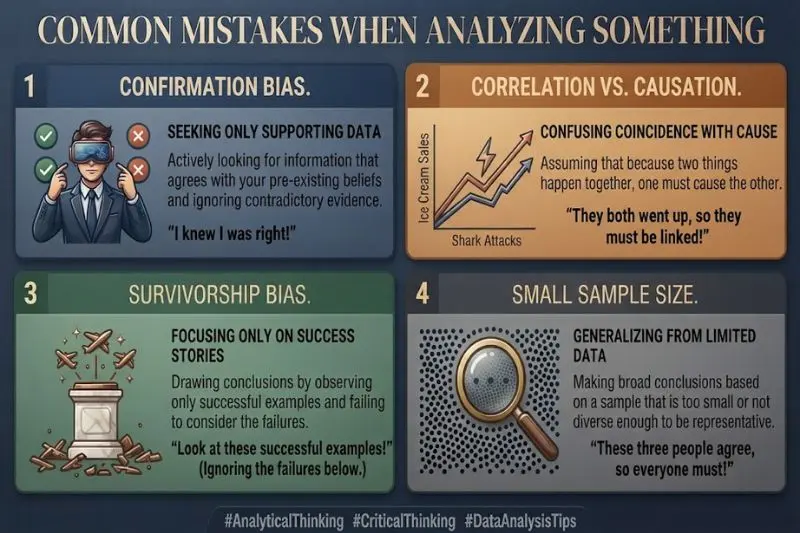
Jumping to Conclusions
One of the biggest mistakes is deciding the answer before examining the evidence.
Instead of:
“Sales are low because the website has bad SEO.”
Ask:
“What evidence explains the low sales?”
SEO could be one factor, but it should not automatically be treated as the cause.
Looking at Only One Factor
Many real-world problems have multiple causes.
A business may have good traffic but poor conversions. A student may study for many hours but still perform poorly because the study method is ineffective.
Looking at only one variable can produce an incomplete conclusion.
Confusing Correlation With Cause
Two things happening at the same time does not automatically mean one caused the other.
For example, website traffic and sales might increase during the same month. That does not prove that the traffic increase alone caused the sales increase.
Other factors may have changed too.
Ignoring Contradictory Evidence
Sometimes evidence does not support your first assumption.
Do not ignore it.
A strong analysis considers information that challenges the initial explanation and adjusts the conclusion when necessary.
A Simple Analysis Formula
For beginners, this framework is easy to remember:
Identify → Break Down → Examine → Compare → Explain → Conclude
Identify
Define exactly what you are studying.
Break Down
Separate it into meaningful parts.
Examine
Look at the relevant facts and evidence.
Compare
Find patterns, differences, and relationships.
Explain
Determine what the evidence means.
Conclude
Give a logical conclusion supported by what you found.
This framework can be applied to a website, business problem, article, dataset, exam result, marketing campaign, or many other subjects.
When Analysis Is Most Useful
Analysis becomes especially valuable when the answer is not immediately obvious.
It can help you:
- Find the cause of a problem
- Compare different options
- Understand performance
- Identify opportunities
- Make better decisions
- Evaluate arguments
- Interpret data
- Improve a process
- Find weaknesses
- Understand why something happened
The key is to move beyond “What happened?” and investigate “Why did it happen, what does the evidence show, and what should we do about it?”
Expert Tips for Better Analysis
A basic analysis can help you understand a situation, but a few habits can make your conclusions much stronger.
Start With a Specific Question
Instead of analyzing everything, define