Introduction
Online news can reach thousands—or millions—of people within minutes. That speed is valuable, but it creates a serious problem: false or incomplete information can spread just as quickly as accurate reporting.
For journalists, fact-checking is the process of verifying claims, sources, figures, images, quotes, and other details before publishing them. It helps ensure that a news story is not only fast but also accurate, credible, and responsible.
This matters even more as audiences increasingly encounter news through social media, video platforms, search engines, and other digital channels. The Reuters Institute’s 2025 Digital News Report found that 58% of respondents across its markets were concerned about their ability to distinguish what is true from what is false in online news.
In that environment, careful verification is not an optional extra. It is one of the foundations of trustworthy online journalism.
What Is Fact-Checking in Online Journalism?

Fact-checking in online journalism means checking whether the factual information in a story is accurate and supported by reliable evidence before—or, when necessary, after—it is published.
A journalist may verify:
- Names, dates, places, and events
- Quotes and statements
- Statistics and research findings
- Information from official documents
- Photos, videos, and other visual material
- Claims made by public figures
- Information found on social media
- Details provided by anonymous or unnamed sources
Fact-checking is different from simply reading a story one more time. Editing can improve clarity, grammar, and structure, while fact-checking focuses specifically on whether the information being presented is true, adequately supported, and placed in the correct context.
For example, if a journalist receives a viral social media post claiming that a particular event happened, reposting the claim is not verification. The journalist may need to identify the original source, check independent reporting, examine available evidence, and determine whether the image or video actually relates to the event.
This distinction is increasingly important because digital content can be misleading even when it looks convincing.
Why Fact-Checking Matters in Online Journalism
It Protects the Accuracy of News
The most basic responsibility of journalism is to provide reliable information. A factual error can change the meaning of an entire story.
A wrong date may make an event appear to have happened earlier than it did. An incorrect statistic can distort the scale of an issue. A misquoted source can make someone appear to support a position they never expressed.
Strong verification reduces these mistakes before they reach the audience.
Reuters’ journalistic standards, for example, place accuracy above speed and state that errors should be corrected promptly and transparently.
The lesson is simple: being first is useful, but being right is essential.
It Builds Trust Between Journalists and Readers
Readers have many choices about where they get information. When a news organization consistently publishes accurate, well-supported reporting, readers have a stronger reason to trust it.
The opposite is also true. Repeated factual errors can damage credibility far beyond a single article.
The 2025 Reuters Institute research found that when people want to check information they suspect may be false or misleading, trusted news sources are among the most commonly identified sources they turn to.
That creates an important responsibility for online journalists: trust must be earned through the quality of the reporting itself.
It Helps Stop Misinformation From Spreading
Online misinformation does not remain in one place. A false claim can be copied into articles, posts, videos, newsletters, and messages, giving it the appearance of credibility through repetition.
Fact-checking interrupts that process.
Instead of simply repeating what is circulating online, journalists can investigate the original claim and explain what the available evidence actually shows.
This is particularly important when reporting on breaking news, elections, public health, disasters, conflicts, or other subjects where inaccurate information can influence real-world decisions.
It Protects People From Misleading Visual Content
Fact-checking is not limited to written claims. Images and videos also require verification.
A genuine photograph can be presented with a false caption. An old video can be described as a recent event. An edited image can be presented as authentic.
Reuters’ verification work highlights techniques such as tracing the origin of visual material, checking its location, and examining available metadata.
This makes visual verification an increasingly important part of online journalism, particularly when social platforms are a major source of breaking information.
Why Speed Makes Fact-Checking More Difficult
Online journalism operates under intense pressure to publish quickly. A journalist may see a developing story appear on social media and know that competitors are already reporting it.
But speed creates a temptation to publish before all the facts have been established.
That can produce a dangerous cycle:
Unverified claim → rushed publication → audience sharing → wider misinformation → difficult correction
A correction published later may not reach everyone who saw the original story.
This is why responsible newsrooms need systems that allow journalists to move quickly without abandoning verification. Fact-checking should be built into the reporting process rather than treated as something that happens only when a problem is discovered.
Automation can help journalists identify and investigate claims faster, but it does not eliminate the need for human judgment. Research from the Reuters Institute notes that automated fact-checking remains limited for complex claims that require context and judgment, meaning human supervision remains important.
How Journalists Can Fact-Check Online Information
Fact-checking does not always require a complicated investigation. The process depends on the story, but journalists can follow a consistent verification approach to reduce avoidable errors.
Identify the Exact Claim
Start by determining exactly what is being claimed.
A vague statement such as “the government changed the rules” is difficult to verify. A specific claim—such as a particular rule changing on a particular date—can be investigated much more effectively.
Ask:
- What exactly is being claimed?
- Who made the claim?
- When was it made?
- What evidence is being presented?
- Can the claim be independently verified?
Breaking a broad statement into smaller factual claims makes the verification process clearer.
Check the Original Source
Whenever possible, go back to the original source instead of relying on screenshots, reposts, summaries, or secondary reports.
For example, if a story refers to a government announcement, the journalist should look for the original government statement or document. If it refers to research, checking the original study is usually more reliable than relying solely on a social media post describing it.
The closer a journalist gets to the original evidence, the easier it becomes to identify missing context or inaccurate interpretations.
Compare Independent Sources
One source may be mistaken, incomplete, or biased.
For important claims, journalists should look for independent confirmation. This does not mean collecting as many sources as possible. It means finding sources that genuinely provide additional evidence.
For example, a major event might be verified through:
- Official records
- Direct witnesses
- Documents
- Relevant experts
- Independent news organizations
- Reliable datasets
- Original research
The quality and independence of the evidence matter more than the number of links collected.
Verify Images and Videos
Visual material should be treated as evidence that requires verification—not automatic proof.
A journalist can investigate:
- Where the image or video first appeared
- When it was created or published
- Whether the location matches the claim
- Whether older material is being presented as new
- Whether the material has been edited
- Whether other reliable sources confirm what it appears to show
This is particularly important during breaking news because old photographs and unrelated videos can quickly be reused to describe new events.
Check Numbers and Statistics
Statistics can make a news story appear authoritative, but numbers can also be misunderstood or presented without context.
When using statistics, journalists should check:
- The original source
- The date of the data
- The sample or population involved
- How the number was calculated
- Whether the statistic has been interpreted correctly
- Whether newer data is available
A percentage without context can easily create a misleading impression.
For example, saying that something “increased by 50%” does not tell the reader whether it increased from 2 to 3 or from 20,000 to 30,000.
Check Quotes Carefully
Quotes should accurately represent what a person said.
Journalists should verify the original recording, transcript, interview, document, or other available source whenever possible.
A quote can become misleading when:
- Words are removed from their context
- A paraphrase is presented as a direct quote
- Two separate statements are combined
- A translation changes the meaning
- A statement is attributed to the wrong person
Accuracy matters even when the general message appears similar.
The Role of Reliable Sources
Not all sources have the same evidentiary value.
A journalist should consider who produced the information, how they know it, and whether the claim can be independently confirmed.
For example, an official document may be the strongest source for confirming what an organization formally announced. An original scientific paper may be more appropriate for verifying a research finding. A firsthand witness may provide useful evidence about what they personally observed, although their account may still need corroboration.
The right source depends on the claim being checked.
This is why fact-checking is not simply a matter of finding a website that agrees with the journalist’s conclusion. It requires evaluating evidence.
Fact-Checking and Breaking News
Breaking news presents one of the hardest challenges for online journalists.
Early information is often incomplete. Details can change as authorities investigate an event, witnesses provide new information, or additional evidence becomes available.
In these situations, journalists should clearly distinguish between:
What is confirmed → What is reported → What is unknown
That distinction protects readers from confusing speculation with established facts.
If information is still developing, saying so is better journalism than presenting an uncertain claim as a confirmed fact.
A responsible update can also explain what has changed since the earlier report. This gives readers a clearer understanding of how the information developed.
What Happens When a News Organization Gets Something Wrong?
Even careful journalists can make mistakes. Fact-checking reduces errors, but it cannot guarantee that every published detail will always be correct.
What matters then is how the organization responds.
A responsible correction should:
- Identify the inaccurate information.
- Correct it clearly.
- Avoid quietly changing a significant error without explanation.
- Update the article when necessary.
- Make the correction understandable to readers.
Transparent corrections can help preserve trust because they show that accuracy matters even after publication.
The goal is not to create the impression that journalists never make mistakes. The goal is to demonstrate that mistakes are taken seriously and corrected responsibly.
Common Fact-Checking Mistakes Journalists Should Avoid
Relying on a Single Source
One source may provide useful information, but important claims often require additional verification.
Better approach: Look for independent evidence when the claim is significant or disputed.
Treating Social Media Posts as Evidence
A viral post can be a lead, but popularity does not prove accuracy.
Better approach: Use the post to identify a claim and then investigate the underlying evidence.
Confusing a Source With Proof
An expert, official, or organization can still make an incorrect statement.
Better approach: Evaluate the evidence behind the claim rather than accepting it solely because of who made it.
Ignoring Context
A statement can be technically accurate but misleading when important context is removed.
Better approach: Check the surrounding circumstances, timeframe, methodology, and original wording.
Publishing Before Verification Is Complete
Pressure to beat competitors can encourage premature reporting.
Better approach: Clearly label what is confirmed and wait for verification before presenting uncertain information as fact.
Fact-Checking in the Age of AI
Artificial intelligence has made it easier to create and distribute text, images, audio, and video at scale. That increases the importance of verification.
AI-generated material can look convincing without being factual. At the same time, AI tools can help journalists organize information, identify claims, search large collections of documents, or flag material that needs closer examination.
The important distinction is that an AI tool can assist the verification process, but it should not automatically replace journalistic judgment.
A journalist still needs to determine whether a claim is supported by credible evidence and whether the evidence has been interpreted correctly.
The same principle applies to AI-generated summaries. A summary can sound confident while leaving out an important qualification or misunderstanding the original source.
For online journalism, verification remains a human responsibility even when technology helps make the process faster.
Why Fact-Checking Benefits Readers
For readers, accurate journalism provides more than correct information. It helps them make better decisions.
People use news to understand events, evaluate public claims, discuss important issues, and decide what actions to take. If the information is wrong, the consequences can extend beyond a single article.
Good fact-checking gives readers confidence that:
- Claims have been investigated.
- Important information has supporting evidence.
- Uncertainty is acknowledged.
- Corrections are handled responsibly.
- Facts are separated from speculation.
That makes fact-checking a service to the audience, not simply an internal newsroom procedure.
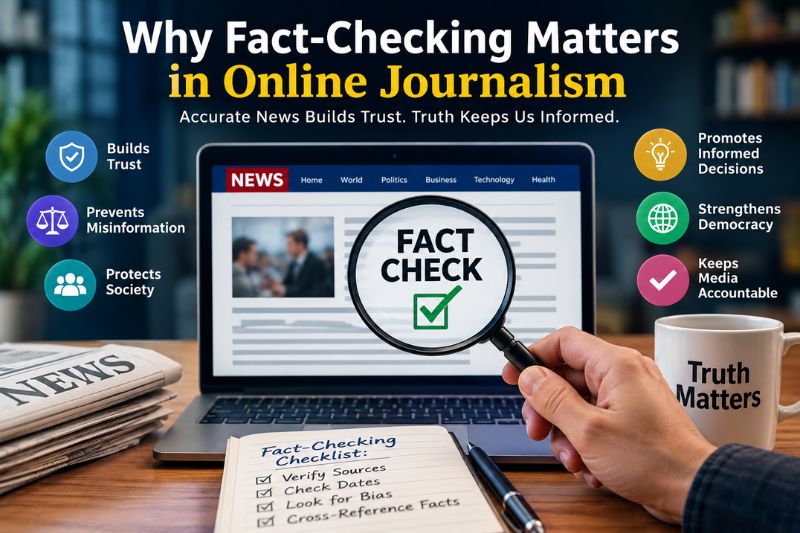
A Practical Fact-Checking Checklist
Before publishing an important online news story, a journalist can ask:
- Who made the claim?
- What exactly was said?
- What is the original source?
- Can the claim be independently verified?
- Are the dates and numbers correct?
- Are quotes accurate and properly attributed?
- Are images and videos authentic and correctly described?
- Is important context missing?
- What remains uncertain?
- Could the wording accidentally make an unverified claim sound confirmed?
These questions will not solve every verification challenge, but they provide a practical framework for catching many common problems before publication.
The Difference Between Verification and Opinion
Fact-checking does not mean removing opinions from journalism.
News organizations may publish analysis, commentary, and opinion, but readers should be able to distinguish an opinion from a factual assertion.
For example, saying “this policy is harmful” is an evaluative judgment. Saying “the policy reduced spending by 20%” is a factual claim that can be investigated.
Clear labeling and careful wording help readers understand the difference.
This distinction is particularly valuable online, where news reports, commentary, advertisements, influencer content, and personal posts can appear next to one another in the same feed.
The Future of Fact-Checking in Online Journalism
Fact-checking will become even more important as the online information environment becomes faster and more complex. Journalists now work with information from social media, user-generated content, automated systems, artificial intelligence, and constantly changing digital platforms.
This does not mean every piece of information requires a lengthy investigation. Instead, journalists need to become better at recognizing which claims require deeper verification and which can be confirmed quickly through reliable sources.
Technology can support this work, but the fundamental responsibility remains the same: determine whether the information is accurate before presenting it as fact.
Technology Can Assist, But Verification Still Matters
Digital tools can help journalists search large datasets, compare documents, identify duplicate images, analyze video, and track where information originated.
These tools can make verification faster, especially when journalists are dealing with large amounts of material.
However, technology should be treated as an aid rather than automatic proof. A search result, AI-generated answer, or automated detection system can still contain errors.
The journalist must ultimately evaluate the evidence and decide whether a claim is sufficiently supported.
Transparency Is Becoming More Important
Readers increasingly want to know where information comes from and how journalists reached their conclusions.
For that reason, transparent reporting can strengthen trust.
When appropriate, journalists can explain:
- Where important information came from
- Which sources were consulted
- What evidence supports a claim
- What remains uncertain
- Why a correction was made
- When information was updated
This does not mean revealing confidential sources or publishing every detail of an investigation. It means giving readers enough context to understand why the reporting is credible.
How Fact-Checking Strengthens Online Journalism
Fact-checking contributes to nearly every major part of quality digital journalism.
Accuracy: It reduces factual errors.
Credibility: It gives readers stronger reasons to trust a publication.
Context: It prevents isolated claims from being presented in misleading ways.
Accountability: It encourages journalists and news organizations to take responsibility for what they publish.
Public understanding: It helps readers distinguish verified information from rumors, speculation, and unsupported claims.
These benefits are connected. Accurate reporting supports trust, and trust makes it more likely that audiences will turn to reliable journalism when they need information.
Fact-Checking Is Not About Slowing Journalism Down
A common misconception is that verification and speed are opposites.
They do create a tension, especially during breaking news, but good newsroom processes can support both.
A journalist does not necessarily need to wait until every detail is known before publishing. Instead, the report can clearly communicate the level of certainty.
For example:
- Confirmed: Information supported by reliable evidence.
- Reported: Information attributed to a credible source but not independently confirmed.
- Unclear: Details that remain uncertain.
- Updated: Information that has changed as new evidence became available.
This approach allows journalists to inform readers without giving false certainty.
The goal is not to eliminate speed. It is to prevent speed from becoming an excuse for avoidable inaccuracies.
What Readers Can Do to Recognize Well-Checked Journalism
Fact-checking is primarily a journalistic responsibility, but readers also benefit from developing basic verification habits.
Before believing or sharing an important claim, readers can ask:
- Who published it?
- Is there an identifiable source?
- Does the original source support the claim?
- Are other reliable sources reporting the same information?
- Is the information current?
- Could the headline be exaggerating what the article actually says?
- Is an image or video being presented without enough context?
These questions are especially useful when a story triggers a strong emotional reaction.
A surprising or alarming claim deserves more verification, not less.
Why Fact-Checking Matters for the Future of Journalism
Online journalism has made news faster and more accessible than ever. A person can learn about an event on the other side of the world almost immediately.
But accessibility alone does not guarantee quality.
The value of journalism depends partly on its ability to separate reliable information from unsupported claims. That makes fact-checking a core part of responsible reporting.
As misinformation becomes easier to produce and distribute, journalism’s role is not simply to publish information faster. It is to verify, explain, contextualize, and correct information responsibly.
Readers do not need journalists to pretend that uncertainty does not exist. They need journalists to clearly explain what is known, what is not known, and what evidence supports the reporting.
What is fact-checking in online journalism?
Fact-checking is the process of verifying factual claims, sources, statistics, quotes, images, videos, and other information before or after publication. Its purpose is to ensure that published journalism is accurate and properly supported by evidence.
Why is fact-checking important in digital journalism?
Fact-checking helps prevent misinformation, protects journalistic credibility, improves accuracy, and gives readers more reliable information. It is especially important online because false claims can spread rapidly through social media and other digital platforms.
How do journalists verify information?
Journalists may check original documents, contact sources directly, compare independent reports, examine research, verify photographs and videos, check statistics, and investigate the context surrounding a claim.
Can journalists trust information from social media?
Social media can provide useful leads and firsthand material, but a social media post should not automatically be treated as verified evidence. Journalists should investigate its source, context, date, authenticity, and supporting evidence.
Does fact-checking make news slower?
Verification can take additional time, particularly for complex or breaking stories. However, journalists can still report quickly by clearly distinguishing confirmed facts from unverified or developing information.
Can artificial intelligence replace fact-checkers?
AI can assist journalists with tasks such as finding information, organizing documents, and identifying material that needs investigation. However, AI output can also contain errors, so human verification and editorial judgment remain important.
What should journalists do when they publish incorrect information?
They should correct significant errors clearly and promptly, update the affected content when appropriate, and be transparent about what was wrong. Responsible corrections help maintain accountability and reader trust.
Practical Tips for Better Fact-Checking
A strong fact-checking process does not have to be complicated. The most useful habit is to slow down when a claim matters.
Before publishing, focus on the details most likely to cause harm if they are wrong. Verify names, numbers, dates, quotes, locations, visual material, and claims that could significantly influence how readers understand an event.
It also helps to separate reporting from assumption. If something has not been confirmed, say that it has not been confirmed.
Most importantly, do not allow the pressure to publish first to replace the responsibility to publish accurately.
The Bottom Line
Fact-checking matters in online journalism because accuracy is the foundation of credible reporting. Without verification, even a well-written story can spread incorrect information, damage trust, and confuse readers.
Effective fact-checking involves checking original sources, comparing evidence, verifying statistics and visual content, confirming quotes, identifying missing context, and clearly communicating uncertainty.
The digital news environment will continue to change, and new technologies will create both opportunities and challenges for journalists. But the basic principle will remain the same: before asking readers to trust a story, journalists should have good reason to trust the facts behind it.
That is what makes fact-checking more than an editorial step. It is a fundamental responsibility of online journalism.Practical Tips for Better Fact-Checking
A strong fact-checking process does not have to be complicated. The most useful habit is to slow down when a claim matters.
Before publishing, focus on the details most likely to cause harm if they are wrong. Verify names, numbers, dates, quotes, locations, visual material, and claims that could significantly influence how readers understand an event.
It also helps to separate reporting from assumption. If something has not been confirmed, say that it has not been confirmed.
Most importantly, do not allow the pressure to publish first to replace the responsibility to publish accurately.
The Bottom Line
Fact-checking matters in online journalism because accuracy is the foundation of credible reporting. Without verification, even a well-written story can spread incorrect information, damage trust, and confuse readers.
Effective fact-checking involves checking original sources, comparing evidence, verifying statistics and visual content, confirming quotes, identifying missing context, and clearly communicating uncertainty.
The digital news environment will continue to change, and new technologies will create both opportunities and challenges for journalists. But the basic principle will remain the same: before asking readers to trust a story, journalists should have good reason to trust the facts behind it.
That is what makes fact-checking more than an editorial step. It is a fundamental responsibility of online journalism.